The Enlightenment Is of Christian Origin
Christians are often told they must choose: faith or reason, revelation or
inquiry, the church or the modern world.
Pope Benedict XVI did not think so. He thought the choice was a category
error — and that the Enlightenment, of all things, was the proof.
An unlikely witness
On April 1, 2005, Cardinal Joseph Ratzinger accepted the St. Benedict Award
at the Convent of St. Scholastica in Subiaco. John Paul II died the following
day. Eighteen days later, Ratzinger was Pope Benedict XVI.
In that address he made a claim that still has not been absorbed:
"In this connection, the Enlightenment is of Christian origin and it is no
accident that it was born precisely and exclusively in the realm of the
Christian faith."
This is not a concession from a friend of modernity. Ratzinger spent
twenty-four years as the Vatican's chief guardian of doctrine, and was among
the sharpest critics of relativism the last century produced. His argument is
not that Christianity should make peace with reason. It is that Christianity
has always been the religion of reason, and forgot.
The religion of the Logos
"From the beginning, Christianity has understood itself as the religion of
the 'Logos,' as the religion according to reason. In the first place, it has
not identified its precursors in the other religions, but in that
philosophical enlightenment which has cleared the path of traditions to turn
to the search of the truth and towards the good."
Christianity's ancestors, on this reading, are not the religions. They are the
philosophers — those who left inherited tradition behind in order to reason
their way toward the one God.
Three consequences follow, and Ratzinger names them: that the state has no
right to own religion, so faith must be free; that every human being without
distinction is made in God's image, so every human being holds the same
dignity; and that reason is not faith's rival but its native language.
Why the Enlightenment had to happen
Then comes the hard sentence — the one aimed at the church rather than at its
critics. The Enlightenment arose, Ratzinger says, "whenever Christianity,
against its nature and unfortunately, had become tradition and religion of the
state," because in that condition "the voice of reason had been too
domesticated."
Domesticated. Not rejected — kept. House-trained. Reason was still present in
Christendom, still useful, still fed, and no longer free to go anywhere. So it
went somewhere else.
On this account the Enlightenment is not an attack Christianity survived. It is
a correction Christianity earned:
"It was and is the merit of the Enlightenment to have again proposed these
original values of Christianity and of having given back to reason its own
voice."
Was and is. Present tense. He then points to Vatican II's Gaudium et Spes
for underlining "this profound correspondence between Christianity and the
Enlightenment," and calls it "the great heritage that both sides must defend."
Both sides. Christians and secularists hold the same inheritance and owe it the
same defense.
The question that actually divides us
If faith versus reason is the wrong axis, what is the right one? Ratzinger is
specific:
"…the problem is whether the world comes from the irrational, and reason is
not other than a 'sub-product,' on occasion even harmful of its
development — or whether the world comes from reason, and is, as a
consequence, its criterion and goal."
That is the real fault line. Is reason fundamental to reality, or a late
accident thrown up by a blind process?
Christianity's answer is that the world comes from Logos — that rationality is
not an anomaly in the universe but its origin and its aim. Which means the
Christian claim about reason is the more ambitious one. To reason is not to
work against the grain of things. It is to participate in what the universe is
made of.
What this asks of us
The Christian Transhumanist Affirmation says we are "guided by Jesus' greatest
commands" — including to love God "with all your heart, soul, mind, and
strength" — and that science and technology are "tangible expressions of our
God-given impulse to explore and discover."
Benedict's Subiaco address is a reminder that this is not a novel position. It
is the tradition remembering itself.
And it carries a warning. When Christianity forgets that it is the religion of
the Logos, reason does not disappear. It leaves. Whatever we build now — in
science, in technology, in the pursuit of human flourishing — the question is
whether the church will be a place reason can live, or one more place it has to
escape.
"We Christians must be very careful to remain faithful to this fundamental
line: to live a faith that comes from the 'Logos,' from creative reason, and
that, because of this, is also open to all that is truly rational."— Joseph Ratzinger, Subiaco, April 1, 2005
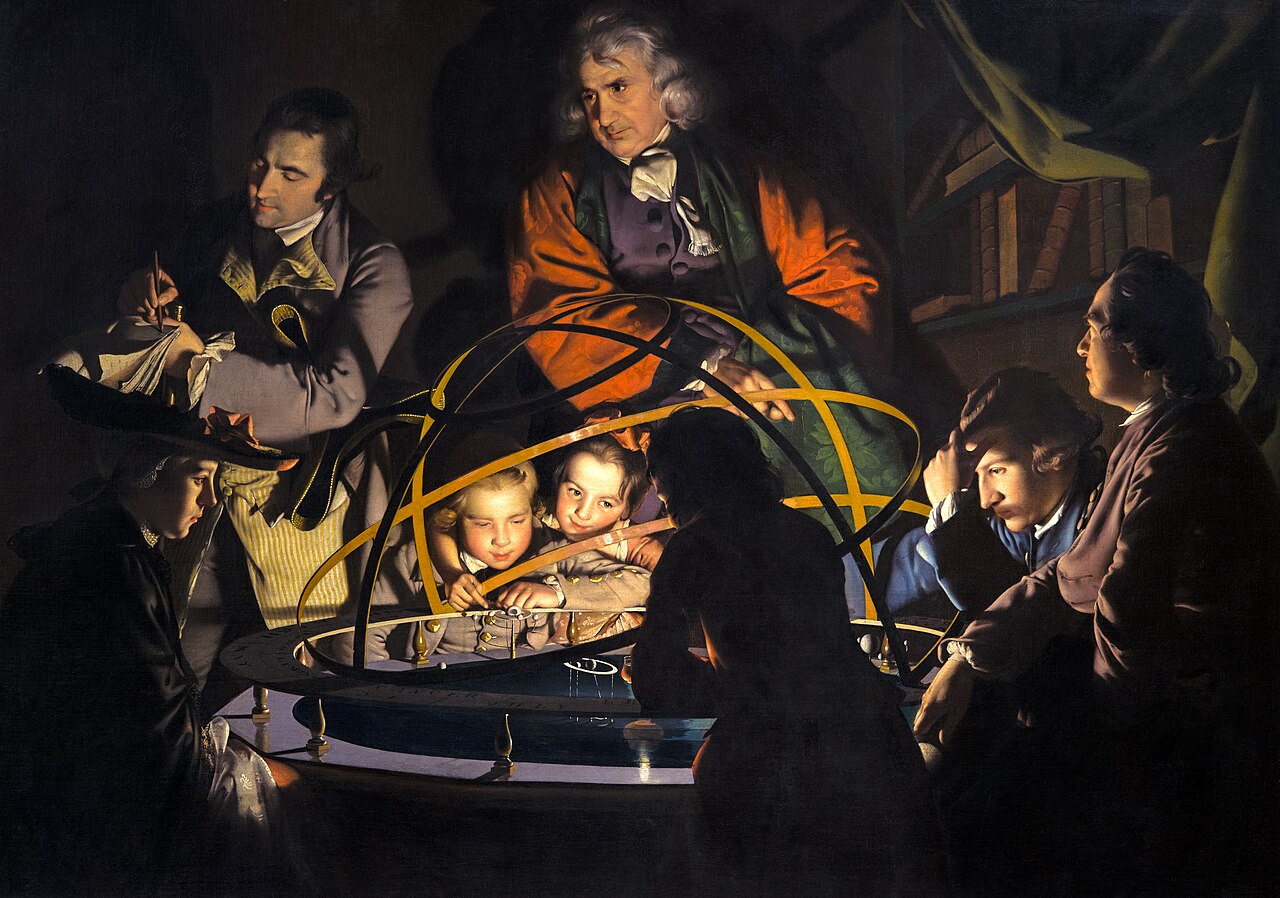
Image: Joseph Wright of Derby, A Philosopher Lecturing on the Orrery (c. 1766), Derby Museum and Art Gallery. Public domain.
Join the conversation
Comments are hosted by Disqus. Loading them will pull in external scripts and cookies.
Guests
- Kevin Kelly
- NT Wright
- Science Mike McHargue
- David Deutsch
- Aubrey de Grey
- Frank Tipler
- Robin Hanson
- Noland Arbaugh
- Robert Wright
- James Hughes
- Steve Fuller
- Liz Parrish
- Thomas Jay Oord
- Greg Boyd
- Philip Clayton
- Adam Ericksen
- Christian Piatt
- Paul Wallace
- Derek Flood
- Katharine Hayhoe
- Christopher Benek
- Robert Walden Kurtz
- Calvin Mercer
- Peter Enns
- Shannon Vyff
- Ron Cole-Turner
- Meghan O'Gieblyn